

 Italiano
Crossfire developed some high valuable technologies to Circular Recycle the EoL based on Crosspreg® materials and technology. They are based on some few simple key concepts:
The Recycling technology must be simple, cheap and environmental friendly.
The cost for recycling must not exceed the Value of the recycled outputs.
The Recycling technology must be tuned and selected according to the articles composition, to facilitate and obtain the highest Secondary Raw Materials Value.
Those Technologies are:
Mechanical Grinding/Compounding
It's ideal, simple and very low cost, when the user have internal possibility to utilize the Secondary Raw Materials, and when the Composite part is made of Crosspreg® Glass Fabric based. Small/medium size EoL articles, production cutoffs, scraps can be grinded in a mechanical grinder to obtain a short/medium length chopped glass particles perfectly wet by Crosspreg® resin. The average content will be about 70% of glass and 30% of resin. The grinded powder will be added of some virgin resin (polyester or PP) and compounded into a twin extruder to sort out the pellets for Injection Moulding. Crossfire would work with the Partner to develop the ideal grinding/compounding parameters to its highest final Value. It will be used for Injection Molding and over-molding with or without composite inserts.
Pyrolysis
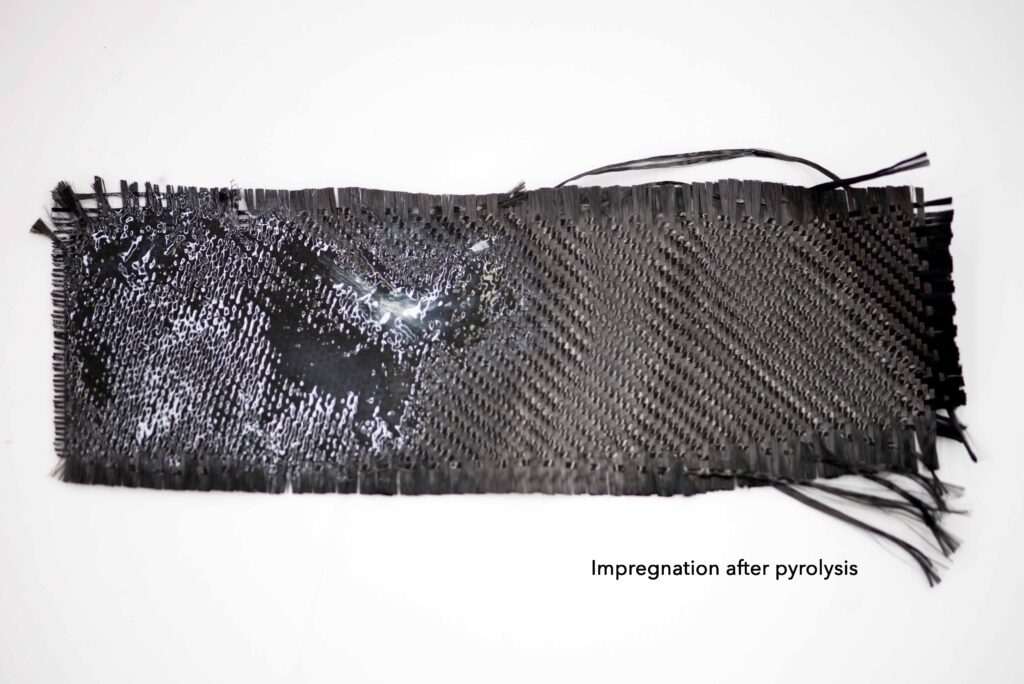
The thermal degradation of the organic Epoxy matrix can give back a Valuable Carbon fabric to a new usage. An industrial Pyrolysis plant is already active in our geographic area, and capable to treat and recover carbon fiber EoL parts and scraps. Given the cost of the Thermal treatment, it’s not worth to be used with Glass fabric whose Value is sensibly lower than that cost, even if technically feasible. The carbon fabric from Pyrolysis is without sizing and this creates problems to its re-use, but, Crosspreg® resin system is equally capable to impregnate it perfectly and create new articles. To be pointed out that parallel test on the Virgin and the Recycled Carbon fabric grade impregnated with Crosspreg® resin, shown very similar performances apart of a larger standard deviation due to the lost perfect fibers alignment.
Solvolysis
The Chemical degradation of Crosspreg® resin is feasible, cheap and quick, with any fabric and sandwich content. The process happens in MEG with a dedicated catalyst, at about 200°C, in minutes, and is without unsafe components. The output is represented by the organic molecular chain drop down to monomers in MEG solution, and the reinforcement (any) over other insoluble components (metal; microchips; incompatible plastics; ..) who separates by filtering the solution. The various Polyester and Epoxy monomers are separated by cooling crystallization, and all the various components are re-usable in a new formulation/composition. The overall value of the recycled materials is a lot higher than the cost to obtain them.
Repair-Reuse
Before of wasting a Crosspreg® based article, a couple of developed technologies could help our Partners.
Repairing is easy and quick just by cleaning the damaged surface and put a Crosspreg® patch over, than keep a bit of pressure while heating and curing. The cured Crosspreg® remains its Ionic activity capable to bond a new uncured patch and consolidates together.
Reuse, with the limits of a material who doesn’t stretch because of the fabric, is a possibility for simple shapes. The cured Crosspreg®, while heated at 180-200°C, is thermoformable in a cold mould in a few seconds.

Crosspreg® Mechanical Recycling Process

Solvolysis & Raw Material Recovery